Although I am not a professional, I have learned several practical techniques for making homemade sausage quickly and with fewer mistakes. One of the most useful lessons is when and how to turn a stuffed casing into individual links. With a little practice and attention to a few key details, the process becomes smoother, faster, and produces more consistent links.
While it is possible to stuff a casing solo, working with a partner generally makes the task easier. When two people establish a rhythm—one feeding the sausage into the casing and the other managing the casing and making the links—you avoid stopping and starting. Pausing the stuffing while someone twists a link often disrupts the flow and can produce uneven link sizes. For consistency and efficiency, it’s best to stuff the entire length of casing first and then form the links.
There are two important points to remember when you’re ready to make links. First, do not overfill the casing: despite the casing’s ability to stretch, too much pressure will cause it to split. Second, don’t wait too long to twist the links. The casing is easiest to work with while it is still moist and pliable; once it dries or cools, it becomes more difficult to manipulate cleanly.
Step #1: Stuff the casing until the entire sausage mixture has been used

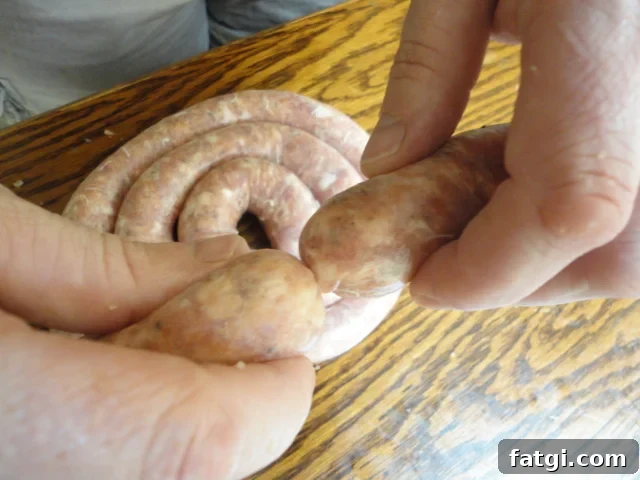
Coil of Homemade Sausage (Bangers)
Start by filling the casing until you have used up the entire sausage mixture. Work steadily and avoid packing in excess meat. If you leave occasional small air pockets, don’t worry—those can be pricked and smoothed out. Keep the stuffed coil coiled or laid out on a clean work surface, ready for portioning into links.
Step #2: Determine the desired sausage link length, press down lightly and begin to twist
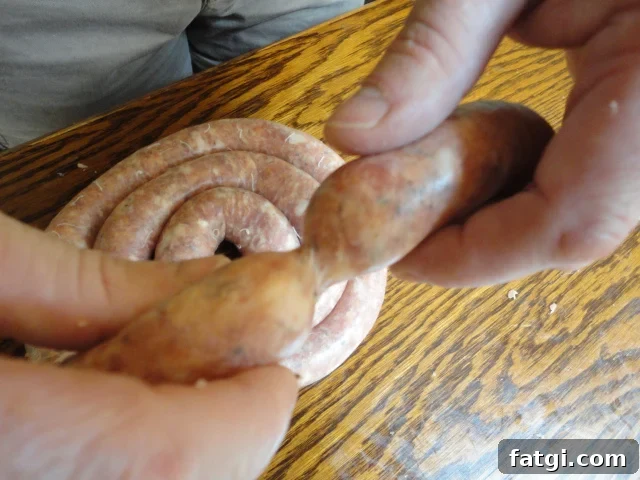
Determine the Desired Length of the Sausage Link, Press Down at that Spot and begin to Twist
Decide how long you want each link to be. Practical sizes vary depending on recipe and intended use, so choose lengths that suit your needs. Lightly press down at the spot where you plan to separate one link from the next—this helps compact the filling and marks the division. Begin the first twist by rotating the casing to form a neck between links.
Step #3: Continue to twist the link an entire revolution (360 degrees)
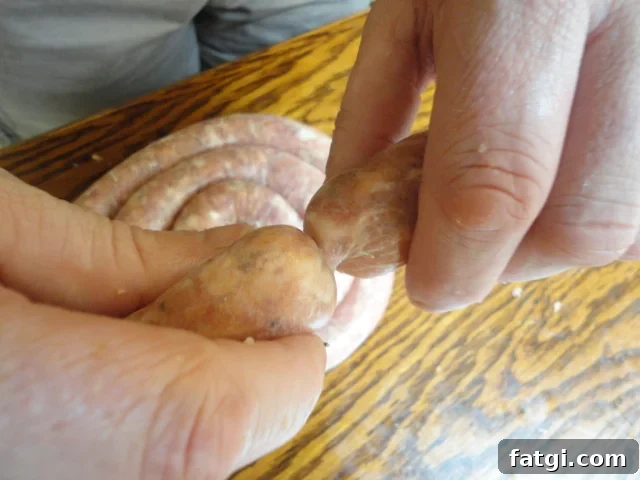
Continue to Twist the Link an Entire Revolution (360 degrees)
After the initial twist, rotate the casing a full revolution. One complete turn helps create a firm, well-defined separation between links. Keep your movements confident but controlled—fast, jerky twists can cause tearing if the casing is overfilled or fragile.
Step #4: Continue twisting the link for an additional complete turn
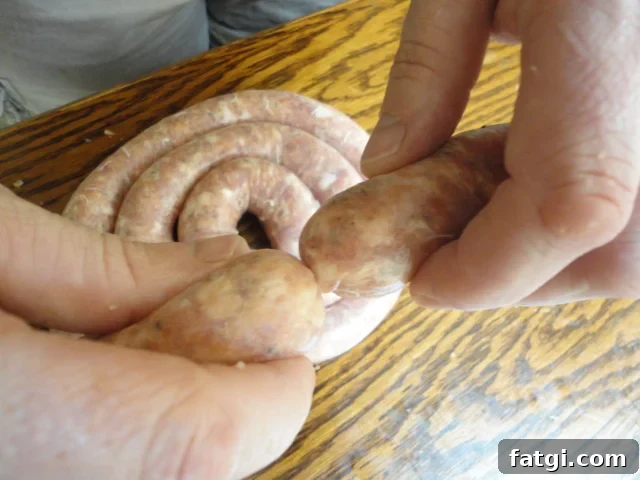
Continue Twisting the Link for an Additional Complete Turn
Complete a second full twist in the same direction. This double twist locks the link in place and reduces the chance of the links unraveling during handling or cooking. If your links are long, you may lightly press the ends after twisting to equalize the filling.
Step #5: Repeat the process until the entire coil has been made into links

Homemade Sausage that has been Twisted into Links
Work methodically along the coil, repeating the sequence of marking, twisting once, and twisting a second time for each link. Keeping a steady pace prevents fatigue and helps maintain consistent link size. If the casing begins to dry, you can lightly moisten it with cold water to restore pliability.
As with any hands-on skill, practice improves speed and consistency. Occasionally the casing will tear despite careful work. When that happens, remove a small section of the exposed sausage and tie knots in the casing on either side of the tear to secure the rest of the coil. The trimmed piece can be fried as a small patty and enjoyed while you prepare the rest of the batch to rest or air-dry in the refrigerator for 24 hours, depending on your recipe.
For many home sausage makers, the act of twisting a long coil into neat, uniform links is especially satisfying. It’s the moment when raw ingredients become recognizable, handheld sausages you can cook, share, and enjoy. With attention to filling, timely twisting, and a steady technique, you’ll find this step becomes one of the most rewarding parts of making homemade sausage.